Showing posts with label Stigmata. Show all posts

Tuesday, October 4, 2022

G.K. Chesterton on S. Francis of Assisi


Mention St Francis of Assisi and many people think of animals, on account of his seeking to live in love, humility and harmony with the whole of creation. His attitude towards animals has justifiably given rise to the blessing of pets on this his feast day. Unfortunately, however, he is often confined to the world of sentiment, diminishing him and trivialising his message. An evangelical Catholic with a broad vision of creation and redemption, Francis was devoted to Christ crucified, from whom he received his vocation to rebuild and renew the Church in such a way that ordinary people are loved into its koinonia.

As an antidote to some of the well-meant sentimentality of this day, I share with you the end of G.K. Chesterton’s St Francis of Assisi. Slightly dated, it is still an amazing essay on the greatness of Francis. The entire work can be read HERE


He was above all things a great giver; and he cared chiefly for the best kind of giving which is called thanksgiving. If another great man wrote a grammar of assent, he may well be said to have written a grammar of acceptance; a grammar of gratitude. He understood down to its very depths the theory of thanks; and its depths are a bottomless abyss.

He knew that the praise of God stands on its strongest ground when it stands on nothing. He knew that we can best measure the towering miracle of the mere fact of existence if we realise that but for some strange mercy we should not even exist. And something of that larger truth is repeated in a lesser form in our own relations with so mighty a maker of history. He also is a giver of things we could not have even thought of for ourselves; he also is too great for anything but gratitude. From him came a whole awakening of the world and a dawn in which all shapes and colours could be seen anew.
 
The mighty men of genius who made the Christian civilisation that we know appear in history almost as his servants and imitators. Before Dante was, he had given poetry to Italy; before St Louis ruled, he had risen as the tribune of the poor; and before Giotto had painted the pictures, he had enacted the scenes. That great painter who began the whole human inspiration of European painting had himself gone to St. Francis to be inspired. It is said that when St Francis staged in his own simple fashion a Nativity Play of Bethlehem, with kings and angels in the stiff and gay mediaeval garments and the golden wigs that stood for haloes, a miracle was wrought full of the Franciscan glory. The Holy Child was a wooden doll or bambino, and it was said that he embraced it and that the image came to life in his arms. He assuredly was not thinking of lesser things; but we may at least say that one thing came to life in his arms; and that was the thing that we call the drama. Save for his intense individual love of song, he did not perhaps himself embody this spirit in any of these arts. 

He was the spirit that was embodied. He was the spiritual essence and substance that walked the world, before any one had seen these things in visible forms derived from it: a wandering fire as if from nowhere, at which men more material could light both torches and tapers. He was the soul of mediaeval civilisation before it even found a body. Another and quite different stream of spiritual inspiration derives largely from him; all that reforming energy of mediaeval and modern times that goes to the burden of Deus est Deus Pauperum. His abstract ardour for human beings was in a multitude of just mediaeval laws against the pride and cruelty of riches; it is to-day behind much that is loosely called Christian Socialist and can more correctly be called Catholic Democrat. Neither on the artistic nor the social side would anybody pretend that these things would not have existed without him; yet it is strictly true to say that we cannot now imagine them without him; since he has lived and changed the world.

And something of that sense of impotence which was more than half his power will descend on any one who knows what that inspiration has been in history, and can only record it in a series of straggling and meagre sentences. He will know something of what St Francis meant by the great and good debt that cannot be paid. He will feel at once the desire to have done infinitely more and the futility of having done anything. He will know what it is to stand under such a deluge of a dead man’s marvels, and have nothing in return to establish against it; to have nothing to set up under the overhanging, overwhelming arches of such a temple of time and eternity, but this brief candle burnt out so quickly before his shrine.

Friday, April 29, 2022

Catherine of Siena and God's grace


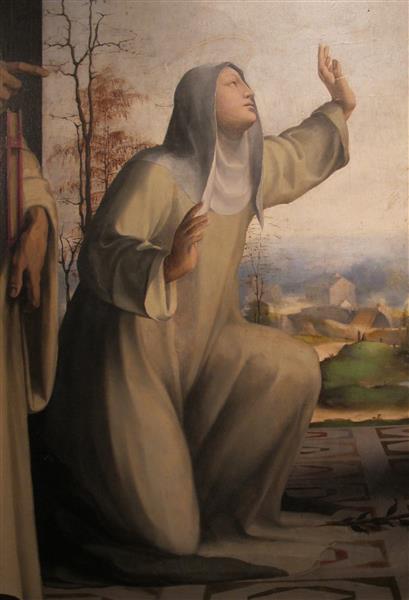
Saint Catherine of Siena receiving the stigmata between Saints Benedict and  Jerome (detail), c.1514 - c.1517 - Domenico Beccafumi - WikiArt.org

“All the way to Heaven is heaven, 
because He said, ‘I am the Way.’" 

- S. Catherine of Siena

Born in 1347, the 24th child of a wool dyer in northern Italy, Catherine was very sensitive to spiritual realities from childhood. From the age of six she could see guardian angels as clearly as the people they protected. Catherine became a Dominican tertiary when she was sixteen, and continued to have visions of Jesus, Mary, and the saints. She was one of the most brilliant theological minds of her day, although she had no formal education. 

At a very difficult time in the Church’s history, Catherine persuaded the Pope to go back to Rome from Avignon, in 1377. She actually died endeavouring to heal the Great Western Schism. In 1375 she received the Stigmata, which was visible only after her death. Catherine’s letters, and a treatise called “a dialogue” are considered among the most brilliant writings of the saints. 

Catherine died in 1380 when she was only 33, and her body was found incorrupt in 1430. Her tomb is in the High Altar of the Church of Santa Maria Sopra Minerva, Rome.


God created us a second time 
in giving us the life of grace

From a Letter of S. Catherine of Siena to Blessed Raymond of Capua

I know of no means of savouring the Truth and living with it, without self-knowledge. It is this knowledge which makes us really understand that we are nothing, that our being came from God when we were created in God’s image and likeness; and also that God created us a second time in giving us the life of grace through the blood of the only Son, blood which has shown us the truth of God the Father.

This is the divine truth: we were created for the glory and praise of God’s name, to enable us to participate in God’s eternal beauty and to sanctify us in God. And the proof that this is the truth? The blood of the spotless Lamb. How are we to know this Blood? By self-knowledge. ’

We were the earth where the standard of the cross was planted. We were the vessel that received the blood of the Lamb as it streamed from the cross. Why did we become that earth? Because the earth would not hold the cross upright; it would have refused such a great injustice. The nails could not have held the Lord fixed and nailed had not his love for our salvation held him there. It was love on fire with the glory of his Father and with desire for our salvation which fixed him to the cross. So, we are the earth which held the cross upright and the vessel which received the blood.

We who can recognize this and live as the spouse of this Truth will find grace in his blood, and all the richness of the life of grace; our nakedness will be the nuptial garment; we will be invested with the fire of love, because the blood and fire mingle and penetrate one another; it is love which has united the blood with the divinity and poured it out.

We must live in simplicity, with neither pretensions nor mannerisms nor servile fear. We must walk in the light of a living faith that shines in more than mere words—and always so, in adversity as well as in prosperity, in times of persecution as well as in times of consolation. Nothing will be able to change the strength or the radiance of our faith if Christ who is the Truth has given us knowledge of truth not just in desire but in living experience.


File:High altar Santa Maria Sopra Minerva.jpg - Wikimedia Commons

The tomb of S. Catherine of Siena in the High Altar of the Church of Santa Maria Sopra Minerva, in Rome.

Wednesday, April 29, 2015

Inspiration from St Catherine


“All the way to Heaven is heaven, 
because He said, ‘I am the Way.’" 

- S. Catherine of Siena

Born in 1347, the 24th child of a wool dyer in northern Italy, Catherine was very sensitive to spiritual realities from childhood. From the age of six she could see guardian angels as clearly as the people they protected. Catherine became a Dominican tertiary when she was sixteen, and continued to have visions of Jesus, Mary, and the saints. She was one of the most brilliant theological minds of her day, although she had no formal education. 

At a very difficult time in the Church’s history, Catherine persuaded the Pope to go back to Rome from Avignon, in 1377, and when she died she was endeavoring to heal the Great Western Schism. In 1375 she received the Stigmata, which was visible only after her death. Catherine’s letters, and a treatise called “a dialogue” are considered among the most brilliant writings of the saints. 

Catherine died in 1380 when she was only 33, and her body was found incorrupt in 1430. Her tomb is under the altar in the Church of Santa Maria Sopra Minerva, in Rome.


God created us a second time 
in giving us the life of grace

From a Letter of St Catherine of Siena to Blessed Raymond of Capua

I know of no means of savouring the Truth and living with it, without self-knowledge. It is this knowledge which makes us really understand that we are nothing, that our being came from God when we were created in God’s image and likeness; and also that God created us a second time in giving us the life of grace through the blood of the only Son, blood which has shown us the truth of God the Father.

This is the divine truth: we were created for the glory and praise of God’s name, to enable us to participate in God’s eternal beauty and to sanctify us in God. And the proof that this is the truth? The blood of the spotless Lamb. How are we to know this Blood? By self-knowledge. ’

We were the earth where the standard of the cross was planted. We were the vessel that received the blood of the Lamb as it streamed from the cross. Why did we become that earth? Because the earth would not hold the cross upright; it would have refused such a great injustice. The nails could not have held the Lord fixed and nailed had not his love for our salvation held him there. It was love on fire with the glory of his Father and with desire for our salvation which fixed him to the cross. So, we are the earth which held the cross upright and the vessel which received the blood.

We who can recognize this and live as the spouse of this Truth will find grace in his blood, and all the richness of the life of grace; our nakedness will be the nuptial garment; we will be invested with the fire of love, because the blood and fire mingle and penetrate one another; it is love which has united the blood with the divinity and poured it out.

We must live in simplicity, with neither pretensions nor mannerisms nor servile fear. We must walk in the light of a living faith that shines in more than mere words—and always so, in adversity as well as in prosperity, in times of persecution as well as in times of consolation. Nothing will be able to change the strength or the radiance of our faith if Christ who is the Truth has given us knowledge of truth not just in desire but in living experience.